

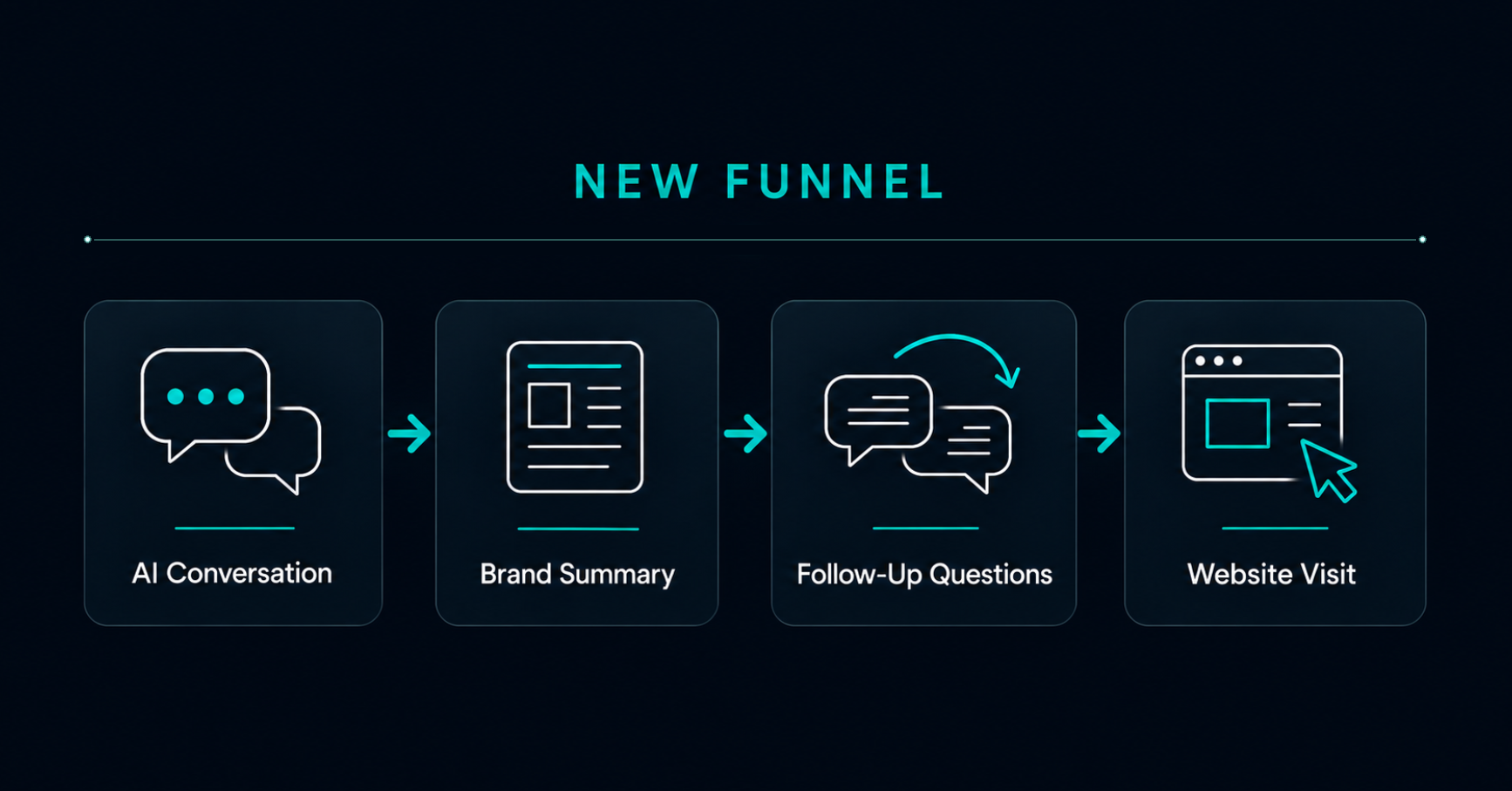
I don’t really search for answers anymore.
I have a conversation instead. I ask, it answers, I push back, it sharpens, and somewhere in that back-and-forth I land on what I actually wanted. In my own setup, ChatGPT is my answer engine and Claude is my workhorse.
Once you catch yourself working that way, a marketing question expands. I’ve stopped asking what phrases my clients rank for. I ask what conversations our heroes are having with their AI and search engines. Does my client’s content deserve to be part of the conversation? The fundamentals are the same as traditional SEO; but the behavior and interfaces have changed.
That shift changes the job of SEOs and SEO agencies. We’re no longer only optimizing pages for isolated keyword phrases. We’re trying to understand the full conversation a buyer has while they research, compare, challenge, refine, and decide. Peer recommendations are now the most trusted source of information at 73%, compared to 55% for vendor sites — and by the decision stage, 63% of buyers ask peers about pricing versus just 28% who ask the vendor. The brands that win will be the ones with useful, expert answers across that whole conversation.
From Keywords to Conversational Search: The Lens Keeps Widening
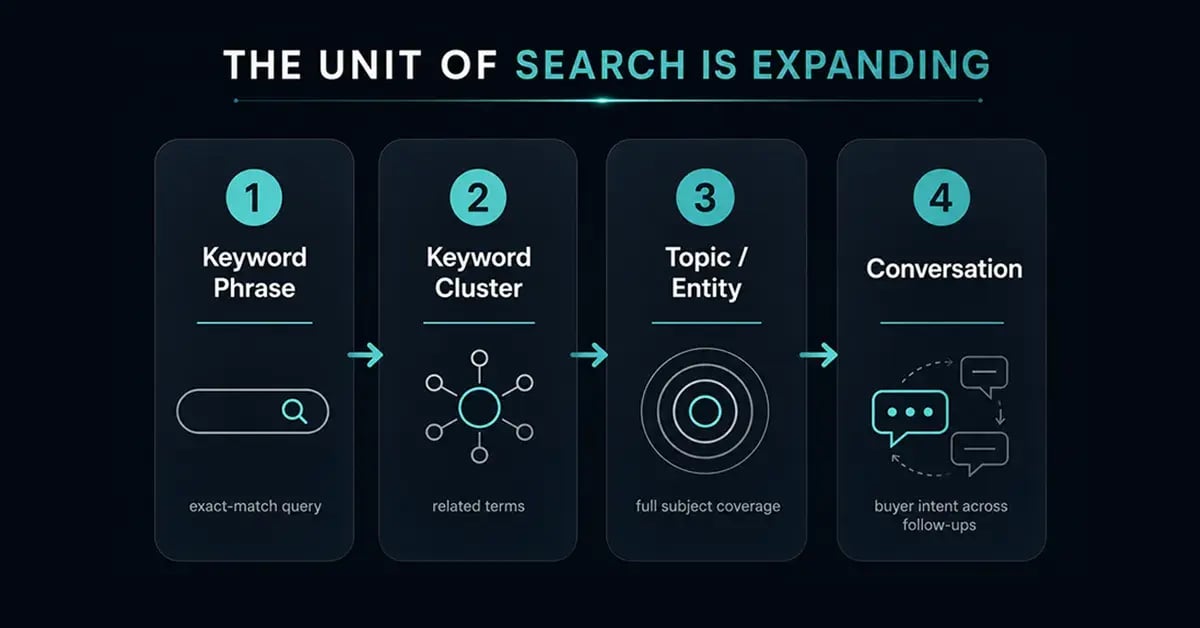
Figure 2: Search has evolved through four stages - starting from a single keyword phrase, to a cluster of related terms, then full topic coverage, and now a conversation that tracks buyer intent across every follow-up.
In the early years, search marketing ran on the keyword phrase. It was always a compression — the smallest box you could cram a messy human intent into so a 2005-era engine could match it. Look at the history and the lens just keeps widening. (Figure 2). Even phrases expanded from two words to three, four… “long tail”.
Every step solved the same problem a little better. What does this person actually want? This conversation stage is just the first version where the user remains semi-anonymous to the brand until they are further down the buyers journey.
| Era | Optimization Unit | What Marketers Did | What Was Missing |
|---|---|---|---|
| Keyword phrase | Exact query | Matched terms | Full intent |
| Keyword cluster | Related terms | Covered variations | Journey context |
| Topic/entity | Subject authority | Built topical depth | Buyer dialogue |
| Conversation | Evolving intent | Answers across follow-ups | Your Heroes’ real need |
The search query morphs into a conversation
Here’s the shift in real life. In the old days, a buyer typed “find an SEO company in Pittsburgh.” One phrase. One results page. Ten links.
Today that same buyer opens a conversation: “What makes SEO agencies successful, and how do I recognize the good ones?” Then it branches. “What should I pay?” “What are the red flags?” “How do I know they’re white-hat?” “Who’s any good in western PA?”
One query just became a multi-step discovery — question, refinement, research. And this isn’t only a Google thing. Google’s AI Mode invites you to keep exploring follow-up questions and pick up where you left off. ChatGPT weighs the full context of the chat. Perplexity remembers what you asked a minute ago. Under the hood, Google even uses a “query fan-out” technique that fires off a bunch of related searches across subtopics to build one answer. Every one of these tools is built for the back-and-forth, not the one-off. The goal isn’t to show up for a single phrase anymore. It’s to show up again and again as the user refines exactly what they’re after. Too often brands build content around their products and NOT their customer’s mission.
Don’t take my word for it. Here’s Google’s own Head of Search describing it:
“Under the hood, AI Mode uses our query fan-out technique, breaking down your question into subtopics and issuing a multitude of queries simultaneously on your behalf. This enables Search to dive deeper into the web than a traditional search on Google, helping you discover even more of what the web has to offer and find incredible, hyper-relevant content that matches your question.”
— Google, “AI in Search: Going beyond information to intelligence”
One question, broken into a multitude. That’s the conversation, happening before the user even types a follow-up.
And this isn’t just my hunch. Researchers have had a name for this for years: conversational information seeking. Google Research’s 2023 monograph defines it as a sequence of interactions between users and an information system, usually through natural-language dialogue. The academics and the product teams landed in the same spot. Search is becoming a dialogue.
The shift in one sentence: a keyword is a guess at intent. A conversation is the intent itself.
Revise your cluster strategy. What is the conversation around each cluster?
In the old model you’d build a keyword cluster — a pile of related phrases with slight variations — and write to it. In the conversation model you start somewhere else entirely. You think about the problem your customer is solving, and you build the content for that problem. The value you provide goes beyond your product and services. It’s the peace of mind or feeling of accomplishment based on the result of your solution. The phrase made famous by Theodore Levitt still rings true “People don't want to buy a quarter-inch drill. They want a quarter-inch hole!”.
At PIC we frame our personas as heroes, and we teach our clients to be the champion who gets that hero through their journey. That gives you a story arc. You build content for everywhere the hero might be — from the first vague research question all the way to the decision. Done right, your client stays in the conversation at every stage, not just the one phrase where they happened to rank. In our Hero Mission Strategy® we call this our “Story Board” workshop.
Take one of PIC’s heroes. We call her Marketing Mary. She’s a marketing director, or a sharp senior coordinator, who owns digital marketing and is on the hook for reporting KPIs to the C-suite — accurately, and with context. Mary is good at her job. But data gets manipulated, software is wrong sometimes, processes quietly break. As a result, she’s always researching how to do it better.
Here’s the part that matters: Mary isn’t shopping for an agency. She’s trying to track her advertising more reliably in Google Analytics, in HubSpot, in the native tools like Google Ads. When she has those problem-solving conversations with her AI, PIC wants to be in them — as the voice that actually helps, not the sales pitch that interrupts.
81% of buyers already have a preferred vendor at the time of first contact, and 85% have largely established their purchase requirements before ever reaching out to sellers.
— 6sense, B2B Buyer Experience Report
Show up useful in Mary’s research long before she’s ready to buy, and you’re the obvious call when she finally is. Referring to Levitt quote above, the Agency is the drill, the marketing and tracking results are the hole. She’s not looking to hire an agency; she’s solving her daily needs.
Which is also why you can’t pull conversations out of a volume tool. Volume reports tell you what got typed. They tell you nothing about Mary’s second and third questions — and that’s where the decision actually happens. The real research input is customer language: sales calls, support tickets, the question your best rep answers fifty times a year, the threads where buyers think out loud. It’s no accident the better AI-visibility tools start with customer language. HubSpot’s AEO tool, for one, recommends which prompts to track straight from your CRM, then measures how often you surface across ChatGPT, Gemini, and Perplexity. Same idea we’re making here — the conversations that matter are yours, and they don’t live in a keyword database.
Your brand awareness starts in the conversation
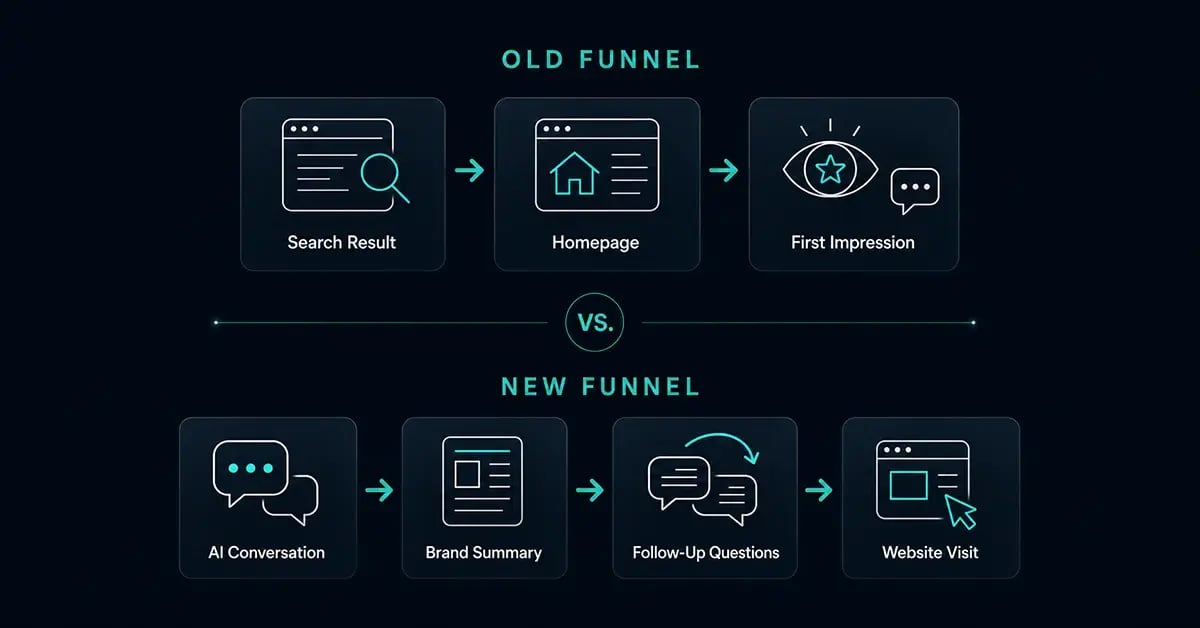
Here’s the part that should change how you think about the top of your funnel. A prospect’s first experience with your brand isn’t a blue link in the awareness stage anymore — 83% of buyers now self-research before they ever talk to sales. A real buyer might have been talking about you inside a Claude project for weeks before they ever filled out your form.
What impression does your brand make when someone starts querying their AI about your service, your reviews, your features? Your home page used to be your first impression. Now your first impression is often whatever ChatGPT or Claude says about you.
Are you tracking your branded conversations? Have you watched the pages that the LLM crawlers are hitting? Watching these signals is critical to crafting the conversations about your brand.
The conversation is OFF your site!
A few years back, I told a client not to let an industry publication print their content first or exclusively. “Why would you give that away? You want the SEO value on your own site.”
I wouldn’t give that advice today.
With the shift to conversations, getting your expertise onto an industry-leading source has gotten more valuable, not less. The AI pulls from wherever the credible discussion is happening — and a lot of that isn’t on your domain. If there are conversations happening in your industry, how are you seeking and participating in them?
The question has changed. Is your brand represented where the conversations actually take place? Run a SaaS company? You’d better be on G2. Industrial or manufacturing? Think Thomasnet. What forums are active in your space? Is the real thought leadership in your industry happening on Reddit, on X, on some other open, indexed platform? Maybe your topics are being argued over in academic papers and peer-reviewed journals.
Part of the shift is getting comfortable having these conversations off your own platform — showing up, usefully and expertly, wherever your hero is already talking and listening.
So how do you win the conversation? Not with slop.
Here’s the trap almost everyone’s walking into. The second AI made content free to crank out, the web filled up with slop — posts built by pointing a model at a dozen existing articles, mashing them together, and re-summarizing. The engines have already named it for what it is. Summary content. AI slop. Period.
And there’s a deeper problem with it: if an AI wrote the whole post, why would anyone read it instead of just asking their own AI? Re-summarized content has no reason to exist. The reader already owns a summarizer. The minute Mary asks her second question — the conditional, the edge case, the “yeah, but in my situation” — generic content has nothing left to say. It was scraped off the surface, so it dies the moment the conversation goes one layer deeper. Only real expertise survives the follow-up.
That’s the whole game now. We recommend a pre-publication sanity check.
The Anti-Slop Test
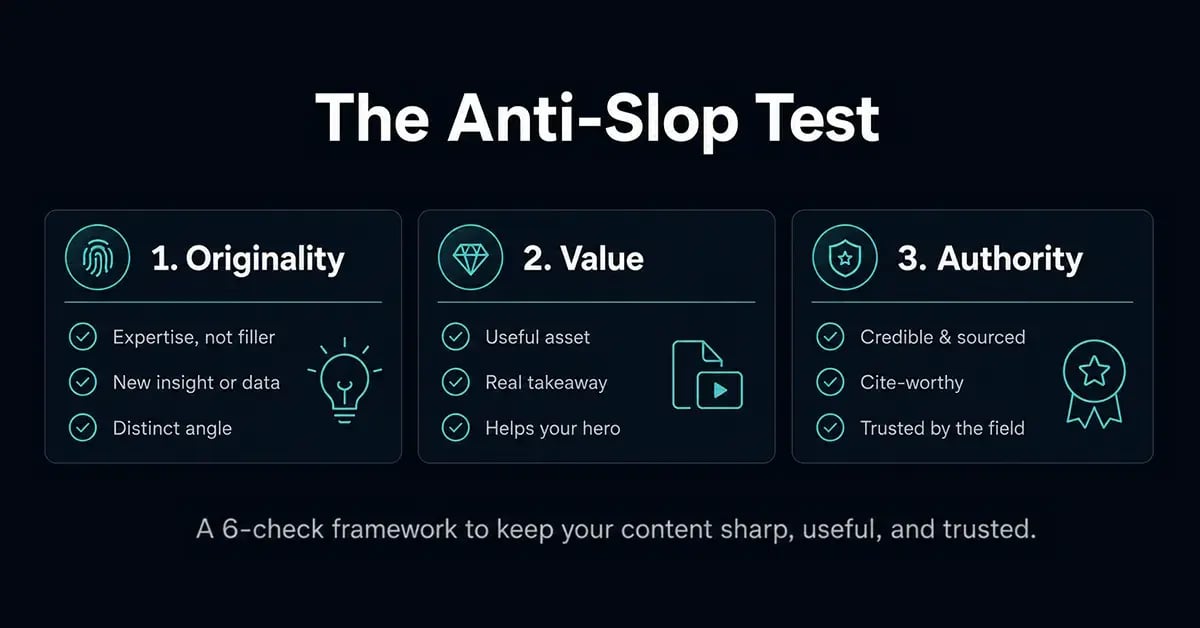
Six questions. If you can’t answer most of them in your favor — honestly — it’s not ready. Doesn’t matter how clean the draft looks.
The Anti-Slop Test: six questions across Originality, Value, and Authority to run before publishing.
Originality — is this actually yours?
- How much did you fake? If a model could’ve written the whole thing with no expert on top, so could everyone else’s model. That’s not content. It’s filler.
- What’s genuinely new here? Point to the take, the data, the example that wasn’t already on page one. Can’t find it? You summarized. You didn’t contribute.
- Is anything cutting-edge or against the grain? Safe, consensus content is the easiest thing in the world for an AI to copy — and the easiest thing for a reader to skip. A real point of view is the moat.
Value — would your hero actually use it?
- Did you add an asset that makes this the best version out there? An original infographic, a video, a calculator, a template. Something that took real effort and makes your page the one worth citing. (We argue this point in the post, so we built a one-page version of this very test. Practice what you preach.)
- If your hero found this, would they read it and get value? Not “would it rank.” Would Mary finish it and walk away better at her job? If you’re not sure, you wrote it for the algorithm, not the human.
Authority — would the field stand on it?
- Would another creator cite your post as a source? Highest bar, and the truest one. People cite what’s original, credible, and useful. If no expert in your space would link to it, no answer engine has reason to either.
It’s really one test asked six ways. Did a real expert make something worth the reader’s time, or did a machine make something to fill a content calendar? The engines are getting very good at telling the difference. So is Mary.
Note: Google's own researchers recently confirmed the scale of this problem — and their solution. Their Scalable Cluster Termination System doesn't just flag bad content; it identifies entire networks of accounts publishing the same AI-generated narrative templates and terminates the cluster.
Real thought-leader conversations need real thought leaders
No way around the punchline. If you want genuine thought-leader conversations, you need actual thought leaders having them.
Sure, marketing teams can use writers, do research, run interviews, pull knowledge out of their experts. All of that works. But by far the most effective move is to get your subject-matter experts onboard with the content process itself — in the planning and the creation, not just quoted at the end. That’s the difference between content that sounds expert and content that is.
None of this means dropping AI. Not even close. Use it for research, for finding sources, for structure, for your SEO, for figuring out what your hero needs, for getting you to a 60% draft. That’s huge leverage on the way to a finished post. This piece is a good example — there’s plenty of AI in it. But every thought in it is mine. That last stretch, the judgment and the point of view and the lived experience, is exactly what the test is built to protect. It’s the one part a slop machine can’t fake.
The keyword isn’t dead. It got absorbed.
Here's the tell that this journey is still hidden. Reddit and SurveyMonkey's own survey lists "chatbots" as the least-used research channel at 18% — while the same report shows Reddit is the #1 most-cited domain in LLM answers for B2B queries. Both can't be true unless the category is broken. Buyers aren't "using a chatbot." They're having conversations — in ChatGPT, in Claude, in Google's AI Mode, where the survey just counts them as "search engines." The behavior moved. The measurement hasn't caught up. That's why this part of the journey stays hidden — and why brands showing up in it now are early, not late.
And to be clear, nobody’s saying search is dead. It’s evolved again with a fresh layer. The research tells a subtler story: people still reach for Google out of habit, but they turn to AI chat for the harder work — synthesizing, comparing options, narrowing things down (Nielsen Norman Group’s 2025 study found exactly that). People will still type short queries, and clear terms still anchor a page. But the keyword got demoted — from the thing you optimize for to one small signal inside a much bigger conversation. It’s a single word in a sentence the user finally gets to finish.
For a long time our craft was guessing intent from fragments and filling pages to match. The guessing was a workaround for tech that couldn’t hold a real conversation yet. And the filling, if we’re honest, was often slop we got away with. That era is closing on both counts.
The work now is simpler to say and harder to do: understand the actual conversations your hero is having, in full and in their own words, and be the most genuinely useful, expert voice in them — at every stage of the journey.
That’s not a new discipline. It’s the oldest one in marketing. Know your customer better than anyone else, and have something real to say. The tools finally caught up to the goal — and quietly raised the bar for everyone.
Exclusive offer for readers of this blog: Create a FREE hero in our platform.
Want to know which conversations your brand is winning, and which ones it’s invisible in? Let’s talk.
We put this post through our own test
It'd be weak to build the Anti-Slop Test and never run our own work through it. So I did. I handed this exact post to Claude — my workhorse — asked it to score all six questions and be harsh, then I argued with the result. Here's the honest tally, dents and all.
How the math works: each question is worth up to 15 or 20 points, 100 total — the same rubric that's on the Anti-Slop Test one-pager. No hidden curve.
Originality (50 pts)
- How much did you fake? — 19/20. The thinking is mine: the "I don't search anymore" open, Marketing Mary, the Levitt framing, the off-platform reversal. Claude docked a point because the prose was AI-drafted, then rewritten in my voice. I pushed back — the words aren't the work, the judgment is — but I'll take it. Fair reminder.
- What's genuinely new? — 14/15. The Anti-Slop Test, Marketing Mary, and the "if an AI wrote it, why read it?" line are ours. Docked one because the keyword-to-conversation idea is in the water now.
- Cutting-edge or against the grain? — 13/15. "Your homepage is no longer your first impression," and reversing my own past advice, are the edgy parts.
Value (30 pts)
- Did you add an asset? — 15/15. Two infographics and this scorecard. Most posts on this topic have none.
- Would your hero use it? — 13/15. Practical, concrete, and there's a tool at the end. Docked for length — Marketing Mary is busy, and this is a long read. Can't argue.
Authority (20 pts)
- Would another creator cite it? — 18/20. Google's Head of Search, an academic monograph, Nielsen Norman, and Google's own S-CTS research. Docked because none of the data is ours — a self-scorecard is a start, not a study. The next one will have client data behind it.
Total: 92/100.
I didn't publish a 100. A perfect self-score is a marketing asset; a 92 with visible dents is the truth — and the dents are the 8% a machine can't close.
Think I'm grading on a curve? Good — run your own next post through the test and tell me where I'm wrong.