

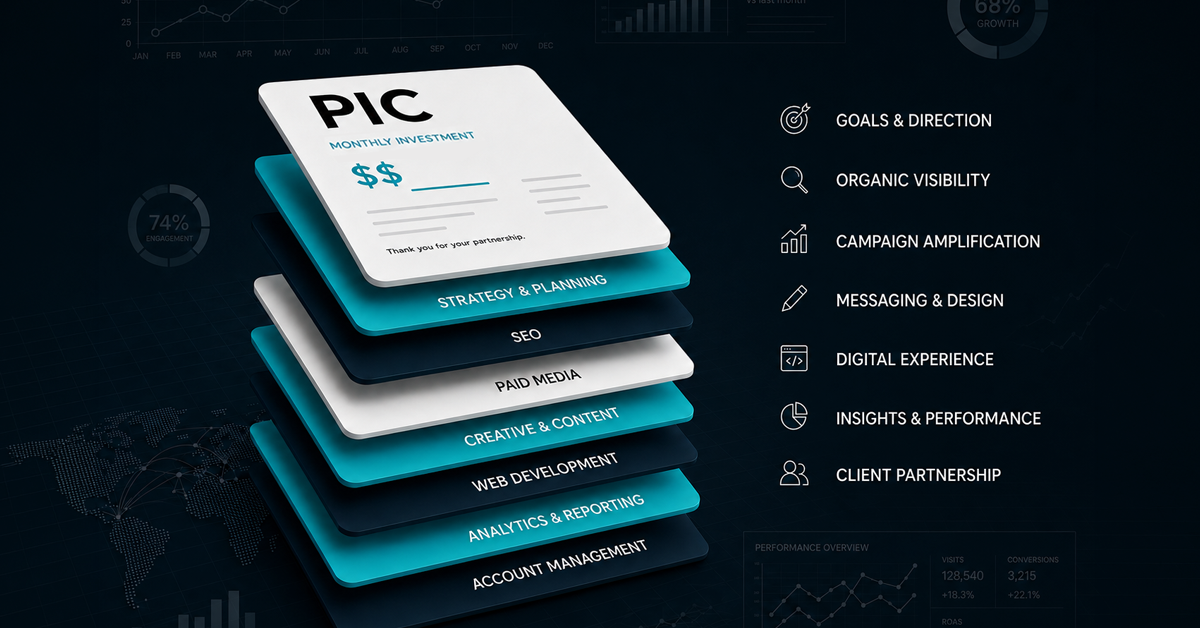
One proposal comes in at $3,000 a month. Another asks for $8,000. A third wants a retainer plus a percentage of ad spend. The real question isn't just what a marketing agency costs, it's what you're actually paying for. And if you're the one who has to document the ROI, the question carries much more weight. You may already know the trap: a low number can hide thin strategy, junior execution, or reporting that never connects to revenue, and a higher number doesn't automatically buy you senior executive attention or real accountability.
Agency pricing depends on scope, channels, goals, and who's doing the work. That's true, but it isn't an excuse for vague quotes or black-box pricing. You should be able to see what drives the fee, what's included, what's separate from ad spend, and how the work is supposed to produce qualified leads and measurable growth. This guide gives you a clear, practical way to understand agency cost in 2026, read a proposal, and recognize a fair quote when you see one, including realistic price ranges by service.
The Short Answer: It Depends, but Not Randomly
Across the market, marketing agency pricing commonly runs from the low thousands to five figures a month for ongoing work. A typical broad range in current pricing discussions is $2,000 to $12,000 per month, with full-service retainers going past $15,000 monthly when the scope, team, and complexity justify it. One-time projects vary even more, because a small audit and a full website rebuild are nothing alike.
For context, most PIC retainer engagements fall between $2,500-$15,000 a month, depending on scope and channel mix. That's not a quote. It's a guide so you can gauge fit before a conversation.
That range is useful for orientation, but it won't make the decision for you. The better question is this: what business problem is this fee designed to solve?
A healthy agency conversation starts with your goals, your current marketing system, your sales process, your internal capacity, and the gap you need an agency to help you close. If an agency hands you a firm price before understanding any of that, the number is convenient. It just isn't very meaningful.
This is why PIC is transparent about process before price. There's no black box, and no canned answer that fits every company. If you're still deciding whether an outside team is the right move at all, our guide to working with a growth marketing agency can help frame that decision before you start comparing proposals.
What Drives the Cost
The digital marketing agency cost on a proposal usually reflects six practical variables: scope, channel mix, cadence, complexity, team seniority, and accountability. When those are unclear, the price is unclear too. Here's how each one moves the number.
Scope: One Service or Full-Funnel Ownership
A narrow engagement costs less because the agency is responsible for less. An SEO audit, paid media management, or an email nurture build is more contained than a full-funnel growth engagement that covers strategy, content, SEO, paid media, reporting, conversion optimization, and CRM alignment.
Scope also includes how much of the customer journey the agency owns.
- Are they just driving traffic?
- Are they helping convert visitors into leads?
- Are they helping Sales figure out which leads are worth chasing?
The broader that ownership the more strategic and operational time the engagement takes.
Channel Mix: Every Channel Has a Different Effort Profile
SEO, AEO/GEO (showing up in AI-generated answers and chat tools, not just traditional search rankings), paid media, content, email, web, social, and CRM work don't demand the same effort at the same moment. SEO can mean technical analysis, content planning, on-page optimization, and authority building. Paid media can mean campaign structure, budget allocation, creative testing, landing page coordination, and steady optimization. Email often leans on segmentation, automation logic, and the quality of your CRM data.
That's why two quotes that both say "digital marketing" can be miles apart. One covers channel execution and nothing else. The other includes strategy, analytics, CRM integration, content production, and sales alignment.
Deliverable Volume and Cadence
Volume matters, but cadence matters just as much. A plan with one monthly blog post, light reporting, and a quarterly strategy check is a different animal from a plan with weekly content, landing pages, ad creative, sales enablement assets, and monthly optimization meetings.
The right question isn't "how many deliverables do we get?" It's "what does this cadence help us learn, improve, and prove?" More output only helps when it serves the growth goal.
Market Competitiveness
Some markets are harder to move than others. A company fighting for space in a crowded B2B category, up against established brands with mature websites and heavy paid media budgets, usually needs a bigger plan than a company entering a quieter niche.
Competitiveness affects keyword difficulty, paid media costs, content depth, conversion strategy, and how much patience the whole thing requires before you see traction.
Team Seniority
Marketing agency rates aren't only about hours. They're about who's applying those hours.
A junior-heavy team can execute tasks, but a growth-stage B2B company usually needs senior judgment: which channel to prioritize, which metrics matter, how to connect marketing to the CRM, what sales feedback is really telling you, and when a tactic needs to change. That strategic layer moves the cost because it changes the value of the work.
If senior marketing leadership is a gap inside your company, fractional / virtual CMO support may be part of the right model. That's different from simply outsourcing tasks.

Common Pricing Models and When Each One Makes Sense
Agencies usually price work through a handful of common models. The model matters because it shapes expectations, communication, and accountability. Here's how the main four compare.
| Pricing model | Best for | Less ideal when | What to watch for |
|---|---|---|---|
| Monthly retainer | Ongoing growth, SEO, content, paid media, lead generation, optimization, and reporting | You only need a tightly defined one-time deliverable | Vague scope, unclear cadence, or weak reporting |
| Project-based | Website projects, audits, strategy work, CRM cleanup, tracking setup, or messaging development | You need ongoing execution and optimization after launch | Unclear handoff, change-order risk, or no plan for what happens next |
| Percentage of ad spend | Paid media management where workload scales with budget and campaign complexity | You need broader strategy outside paid media | Whether incentives favor more spend instead of better efficiency |
| Hourly or consulting | Advisory support, troubleshooting, training, audits, or specialized expertise | You need the agency to own outcomes and execution | Open-ended hours without a defined decision or deliverable |
Budget conversations aren't a trick. A good agency asks because scope depends on what you can responsibly invest. PIC explains this directly in why we ask for a ballpark budget.
Contract Length, Onboarding, and What Happens Before Month One
Cost isn't only the monthly number. It's also how long you're committing to it and what it takes to get started. Most agencies, including PIC, prefer to structure retainers around a 12-month minimum commitment: enough time to build a real foundation and see early signal, without locking you into something that isn't working indefinitely. PIC is somewhat unique in that we let clients cancel at any time.
Before you sign anything, it's worth asking:
- What's the minimum term, and what does renewal look like?
- What's the notice period to pause or cancel?
- Is there a separate onboarding or setup fee, or is that folded into month one?
- What deliverables should you expect to see in month one versus month three?
A fair proposal answers all four without you having to ask twice.
Retainers, Projects, and Ad Spend Are Not the Same Thing
A common source of frustration is the difference between agency fees and ad spend. They're usually separate.
Agency fees pay for the people and the process: strategy, planning, campaign setup, creative direction, content, optimization, reporting, meetings, analytics, and account management. Ad spend is the money paid to platforms like Google, LinkedIn, or Meta to actually place the ads.
That distinction matters because a proposal that says "paid media management" may not include the money to run the ads at all. It might cover campaign management only. If the quote includes a retainer and a percentage of ad spend, ask what each part covers and how performance gets measured.
A fair proposal makes this separation obvious. If you have to guess whether media dollars are included, the proposal isn't clear enough yet.
How Service Mix Changes the Price
Marketing agency cost changes by service, because different services take different skills, timelines, tools, and production levels. Here's a directional look at what each typically runs. Treat these as starting points for a conversation, not a fixed rate card:
- SEO often involves technical analysis, keyword and content strategy, optimization, authority building, and ongoing performance review. It compounds over time, so it often fits a retainer and starts around $350 per month.
- Paid media takes campaign structure, audience strategy, creative testing, landing page coordination, budget management, and frequent optimization. Management fees commonly start around $400/mo or 15–20% of ad spend, kept clearly separate from the media budget itself.
- Content marketing leans on strategy, subject matter expertise, writing depth, editing, design, publishing, and repurposing, typically $300–$2,500/mo depending on volume and depth. Volume without a clear buyer mission just becomes expensive noise.
- Email marketing and nurture can require segmentation, automation, copywriting, design, list hygiene, and CRM integration, often $75-$150/hour or bundled into a broader retainer.
- Web work ranges from landing page improvements to full redesigns, development, UX, analytics, and conversion strategy. Fees range from $150/hr for smaller updates and $5,000-$100,000 as a full project
- Branding and design are often project-based when tied to a defined identity, campaign, or asset system and typically start around $3,000.
- CRM and attribution need clean data, lifecycle stages, reporting logic, and real coordination between marketing and sales; typically, $100-$150/hr for a one-time project or $500+ per month for ongoing maintenance and consulting.
What Should Be Included in the Price
A proposal should tell you what the agency is doing, how often they're doing it, who's responsible, and what's excluded. If it only lists broad services, you aren't seeing the real engagement.
Depending on scope, agency pricing may include:
- Marketing strategy and planning
- SEO research and optimization
- Content strategy, writing, editing, and publishing support
- Paid media setup, management, and optimization
- Landing page recommendations or production
- Email workflows and nurture campaigns
- Analytics setup and reporting
- CRM and HubSpot alignment
- Regular strategy meetings
- Performance analysis and recommendations
It may leave out media spend, third-party software, photography, video production, major website development, copy beyond a defined volume, or anything that depends on your internal IT team. None of those exclusions are automatically a problem. The problem is when nobody states them upfront.
Think in ROI, Not Just Invoice Size
The lowest monthly fee isn't always the lowest risk decision. If an agency costs less but can't produce qualified leads, connect activity to pipeline, or explain what's changing based on performance, it's only cheap on paper.
For a B2B company, better decision metrics include:
- Cost per qualified lead
- Lead-to-opportunity conversion
- Pipeline influenced by marketing
- Sales feedback on lead quality
- Payback period
- Closed revenue attribution, where the CRM allows it
Timeline matters too. Most B2B companies should expect 3-6 months before marketing-sourced pipeline shows up in a meaningful way, and longer in highly competitive categories or when SEO is doing a lot of the early lifting. If an agency promises full pipeline impact inside 30 days, be skeptical of the promise, not excited by the timeline.
This matters most for marketers who have to prove ROI upward, and owners, who want to know whether the investment is helping the business grow and is not just a sunk cost A dashboard full of sessions and impressions doesn't cut it when leadership is asking about pipeline.
If you're trying to evaluate cost through a revenue lens, start with the cost and value of a qualified lead. Sales leaders may also find sales-focused budget strategies useful when marketing investment has to support aggressive targets. And if you need to defend a bigger investment internally, grow your budget using data gives you a practical way to make that case.

Partner vs Vendor: What You Are Really Paying For
Some agency relationships are transactional. The agency completes tasks, sends a report, and waits for the next request. That can work for narrow needs. It doesn't hold up when marketing is expected to generate qualified pipeline and prove revenue impact.
A strategic partner brings more than deliverables. They help define the buyer, clarify the mission, align channels, interpret performance, coordinate with sales, and adjust the strategy when the data or the market shifts.
For PIC, that's the whole purpose of the Walk With You Marketing® model. The goal isn't to hide behind a proprietary black box. Clients should be able to see the tools, the work, the data, and the reasoning behind every recommendation. When HubSpot, CRM data, GA4, SE Ranking, and reporting all line up, the conversation moves from "what did marketing do?" to "what is marketing contributing?"
That's also why the partner vs. vendor distinction matters. If you only need tasks, a vendor may be fine. If you need a growth system that keeps performing after this quarter and holds up when you have to defend it, the relationship has to carry more accountability.
Does Location Affect Agency Cost?
Location can affect expectations, operating costs, and access to senior talent, but it shouldn't be the main reason you select an agency. Fit matters more.
- Does the team understand your market?
- Can they explain the strategy?
- Will they connect marketing to sales outcomes?
- Do you trust them to tell you what's working and what isn't?
PIC is a Pittsburgh-based agency that works with B2B companies across Pennsylvania, the mid-Atlantic, and businesses across the country. For a lot of growth-oriented companies, a regional partner offers the access, transparency, and practical business context they want, without turning the relationship into a distant, account-number experience.
Get a Proposal Built Around Your Actual Goals
So, how much does a marketing agency cost? Enough to fund the strategy, people, tools, execution, and accountability it takes to reach the outcome you care about. That might be a focused project. It might be an ongoing retainer. It might include paid media, SEO, content, HubSpot, CRM alignment, or some combination of all of them.
The number should never be a mystery, and it should never be detached from the mission. You deserve to know what drives the fee, what's included, what's separate, who's doing the work, and how success gets measured.
PIC works best with growth-stage B2B companies ready to invest at least $2,500 a month in a real strategic partnership, not just task execution. If that's where you are:
Want to know what PIC would cost for your specific situation? Get a custom proposal.