

It's been the same since at least 2019. That is when i published the first version of this piece. Now everyone cares again about visibility again, but this time in AEO.
... or AI optimization...AI visibility. Whatever they're calling it this month, the ask is identical: give me the simple trick that turns my historical organic rankings into 2026 traffic and citations.
I've got the answer. I published it in 2019, and almost nobody wanted it then either.
Here's what I wrote on this exact page seven years ago:
"Why are experts willing to dedicate time to very small direct audiences, but unwilling to dedicate time to large audiences and long-term marketing efforts?"
The setup was simple. Your engineers will spend eleven hours on a PowerPoint for a conference breakout with forty people in the room. Your senior people will disappear for two days building a custom proposal that exactly three humans will ever read. Ask those same people for 1500 words on the website and the calendar is suddenly full through the next quarter.
If you are asking your marketing team why your AI visibility is low and not providing them resources to write expert content, you're barking up the wrong tree. Ask them instead what they need from the rest of the organization to deliver that visibility.
In 2026 it's the whole ballgame, and I want to show you why — plus the two things that have to be true after your expert finally writes something, because getting the words out of their head is only half of it.
The two questions that actually decide this
- What can a human do that the AI cannot?
- What can our company do with our content that other companies cannot?
AI-Generated Content Doesn't Break New Ground
That's the first answer, and it's the foundation.
Models compile. They read what exists, find patterns in it, and draw real insight out of it — genuinely useful, and we use it every day. But a model cannot generate information about your topic that didn't exist before a human created it.
Therefore, if your team is on the cutting edge of your field — SaaS, high-end industrial manufacturing, robotics, whatever it is — and you're the ones generating the new trends, then writing about that work is the one thing Claude and ChatGPT cannot duplicate. Not because they're weak. Because the information isn't in there yet. It's in your building.
Google says this about as plainly as Google says anything, in its guidance for generative AI features:
"Don't just recycle what others on the internet have already said or could easily be produced by a generative AI model."
Here's what flipped since 2019. Back then the bottleneck was production — good content was slow and expensive, so whoever published more good content won. Today production costs much less. Anyone can generate forty competent posts on your topic before lunch, and plenty of your competitors already have. Volume stopped being a moat the moment content production became "free".
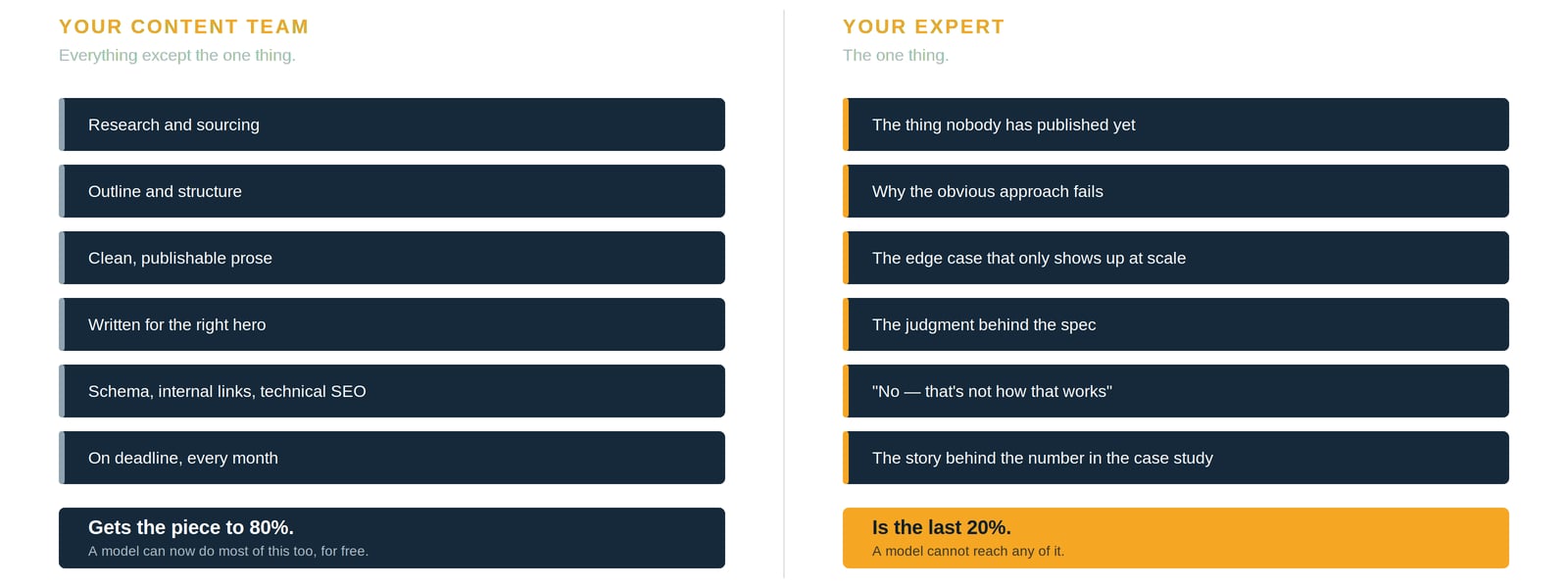
What's scarce now is what was never really about writing at all: somebody who actually knows something. Value. It's the difference between a "content team" and your expert.
So why won't your experts write it?
Same four excuses I heard in 2019. Three of them expired.
"I'm not a writer." You were never being asked to be. More on that in a second.
"It takes too long." This one genuinely got better. You can record a voice memo on a walk and turn it into your first draft. LLMs can find the article you remember, but can't think of where you read it. It can find supporting material to back up your point of view. The time to write a great post is 25% what it was in 2019.
"Marketing can just write it." We can. We'll get it 80% there and it'll read fine. It will also say exactly what the other eleven results say, because that's what we had to work with. The last 20% is the entire value, and it isn't in the post unless a true expert takes it the last mile.
"Nobody reads the blog." Maybe they don't. But your buyer is asking an AI assistant about your category right now, and that assistant answers from what it can find. If everything you know lives in your head, a slide deck, and a proposal PDF, you won't be part of the conversation in their LLM. You will be invisible.
That last one is the real change. In 2019, not publishing meant you ranked lower. In 2026, not publishing thought leadership means there is no reason for AI to cite you as a relevant answer. Your website is stale and its content is replicated on other sources.
The trick that still works after seven years
Here's what I told marketing coordinators in 2019 and still tell them:
"I don't care if the expert thinks the draft is terrible. If I can get them to red-line it, that's as good as if they wrote it."
Experts are murder on a blank page and merciless on a wrong one. Hand a chemical engineer 1500 words with one thing wrong in paragraph three and you'll have notes in twenty minutes. That reflex — no, that's not how that works — is the expertise coming out. It does not care that it's editing instead of writing.
Stop asking them to write. Ask them to correct. Send a draft with the hard part deliberately unresolved. Email four questions and build from the answers. We've run content this way for years, and the red-line pass is where a piece stops sounding like everyone else's.
There's a second version of this, and for some clients it's the only one that works.
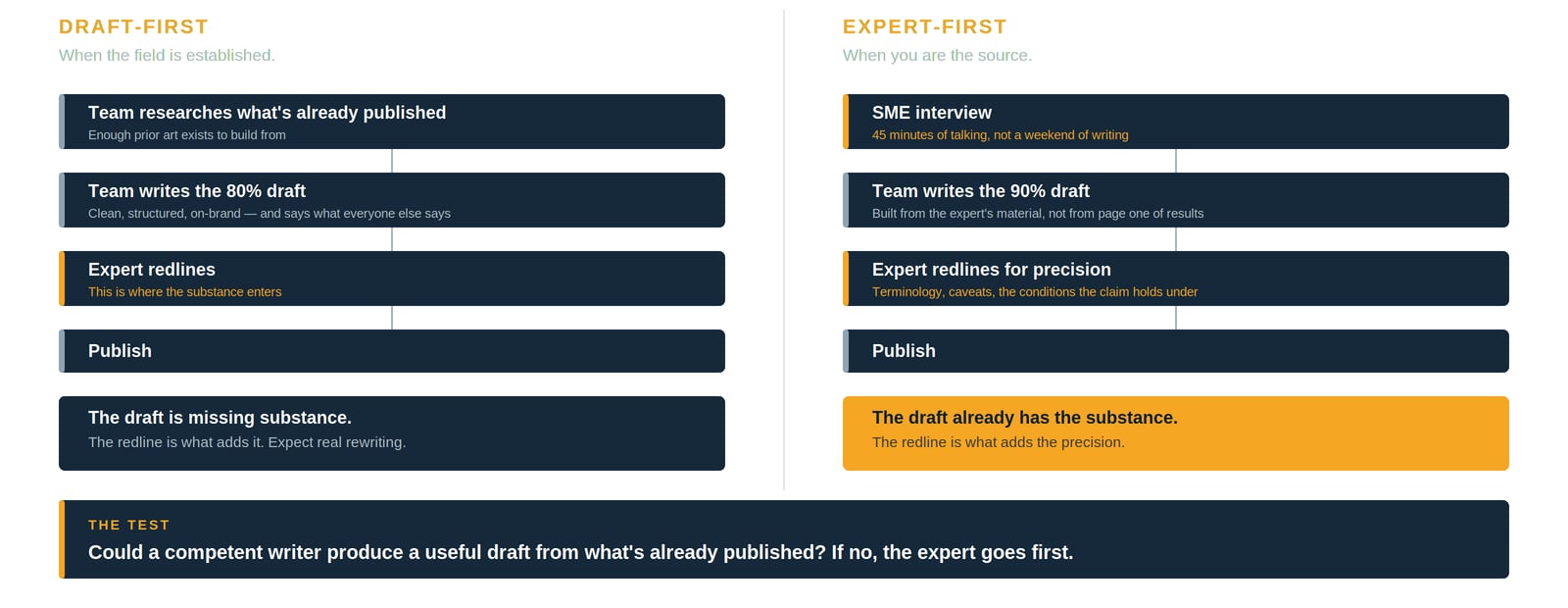
The red-line model assumes we can get you to 80% on our own. That holds when your category has been written about — we read what's out there, build the draft, and your expert fixes what we got wrong.
It falls apart when you're genuinely at the forefront of your field. If your team is working on something cutting edge, the marketing draft becomes nearly useless. A writer working from published sources would produce a summary of everyone else's approximations, which is exactly the slop this post is arguing against.
In high-tech, complicated fields, we suggest running it backwards. We interview the expert first, write the draft from their material instead of from page one of the results, and hand back something that's already 90% complete. The redline still happens; but now it happens after starting with their expertise.
The test for which one you need is a single question. Could a competent writer produce a useful draft from what's already published? If yes, draft first. If no, your expert goes first — and the good news is that costs them forty-five minutes of talking instead of hours of writing.
One thing that did change: put the expert's name on it. Google's content guidance asks whether pages "carry a byline, where one might be expected," and whether those bylines "lead to further information about the author or authors involved, giving background about them and the areas they write about." A ghostwritten post under a generic company byline has no person attached — and a person is exactly what you have and the model doesn't. Your experts need to put their name on the piece.
Unique isn't enough. Unique can be wrong. Your post needs trust.
Say you win the argument and the expert writes. You're halfway.
Anybody can publish something nobody else has said. A lot of it is simply wrong. Uniqueness has to show up wearing the signals the engines have measured for years. Brand citations. Domain authority. Inbound links from places that matter. Brand citations from reputable sources. How long you've been in the market. Whether your industry knows your name. Whether you generate any press.
Google's rater guidelines have carried a version of this for years: raters research the reputation of the site and the creator, specifically among experts in the field. The vocabulary keeps changing — E-A-T, E-E-A-T, whatever's next. The idea hasn't moved.
Unique plus credible gets cited. Unique by itself gets ignored.
And not every mention is a mention
Social gets lumped into AI answer optimization like it's one thing. It isn't. The only question that matters is whether the engine can actually see it. Is it crawlable?
Reddit is the cleanest example — open, indexed, and valuable enough that Google reportedly pays $60 million a year for licensed access. Even that isn't permanent: Reddit has publicly weighed ending the arrangement at renewal. Which is its own lesson — you don't own the pipe. Industry publications, G2, Thomasnet, open forums, real press: a crawler reaches all of it.
Private content doesn't help. Your best thread in a private Facebook group. The sharp back-and-forth in a members-only LinkedIn forum. Your webinar gated behind a form on an industry site. All of these are valid marketing strategies and great for brand lift and awareness. None of them help when your hero asks ChatGPT what they should buy.
LinkedIn has lots of nuance. Read LinkedIn's robots.txt for yourself, Googlebot is blocked from about eighty paths. Public profiles, Company Pages, Pulse articles and post URLs aren't among them. Those CAN get indexed. But if it's not linked to or cited, it's likely to remain invisible. Google has little ability (or desire) to index your post. With that said, my tests were able to pull up many of my own LinkedIn posts, proving they are not invisible to Google.com.
Then I tried to pull up one of my own LinkedIn articles with Claude and got refused. Invisible. Google can see it, Claude cannot. Which one does my audience use? Both. If I want that article on AI watermarks to make it into AEO, PIC will need to publish it on our blog. (and we will)
Google could list my article, Claude couldn't read a word of it. Those are two different results. But we think of them as the same question, is it indexed? The answer can be different depending upon the source that your heroes use.
The silo still works. What fills it changed.
The 2019 version of this post made a case for content silos: build a cluster of pages supporting one topic, own it, make it hard for anyone to catch you. I used the Pittsburgh Penguins as the example.
Here is how I would adjust it today:
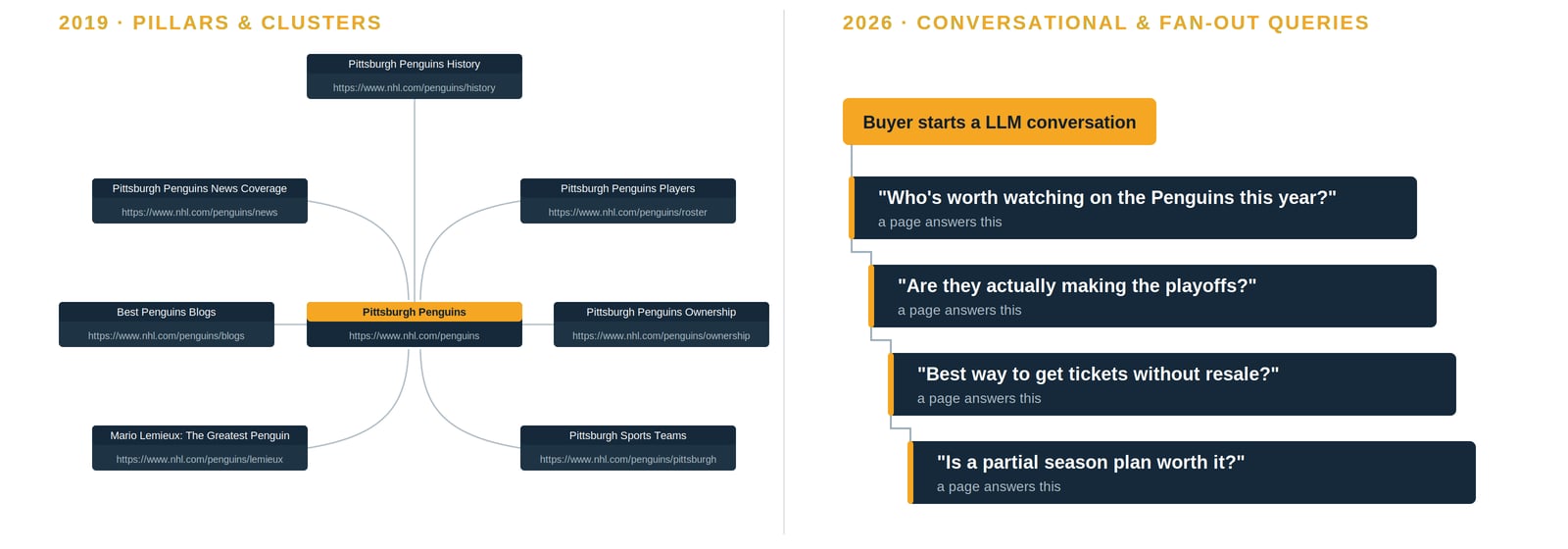
Same team, seven years apart. The shape of the cluster changed. The reason for it didn't.
In 2019 the cluster was built around a phrase. Pages supporting "Pittsburgh Penguins," each targeting a variation. In 2026 the cluster is built around a conversation — because a buyer doesn't type one phrase anymore, they ask, refine, push back, and narrow. It's a conversation, not a search.
Google's own AI Mode breaks a question into subtopics and fires off a batch of related queries to build one answer. The term being used for this is "fan-out queries". You can get a sense of them by looking at the pages Google's AI Overviews cite. Adding more value, originality and assets to the URLs in this report is a great AEO formula for success.
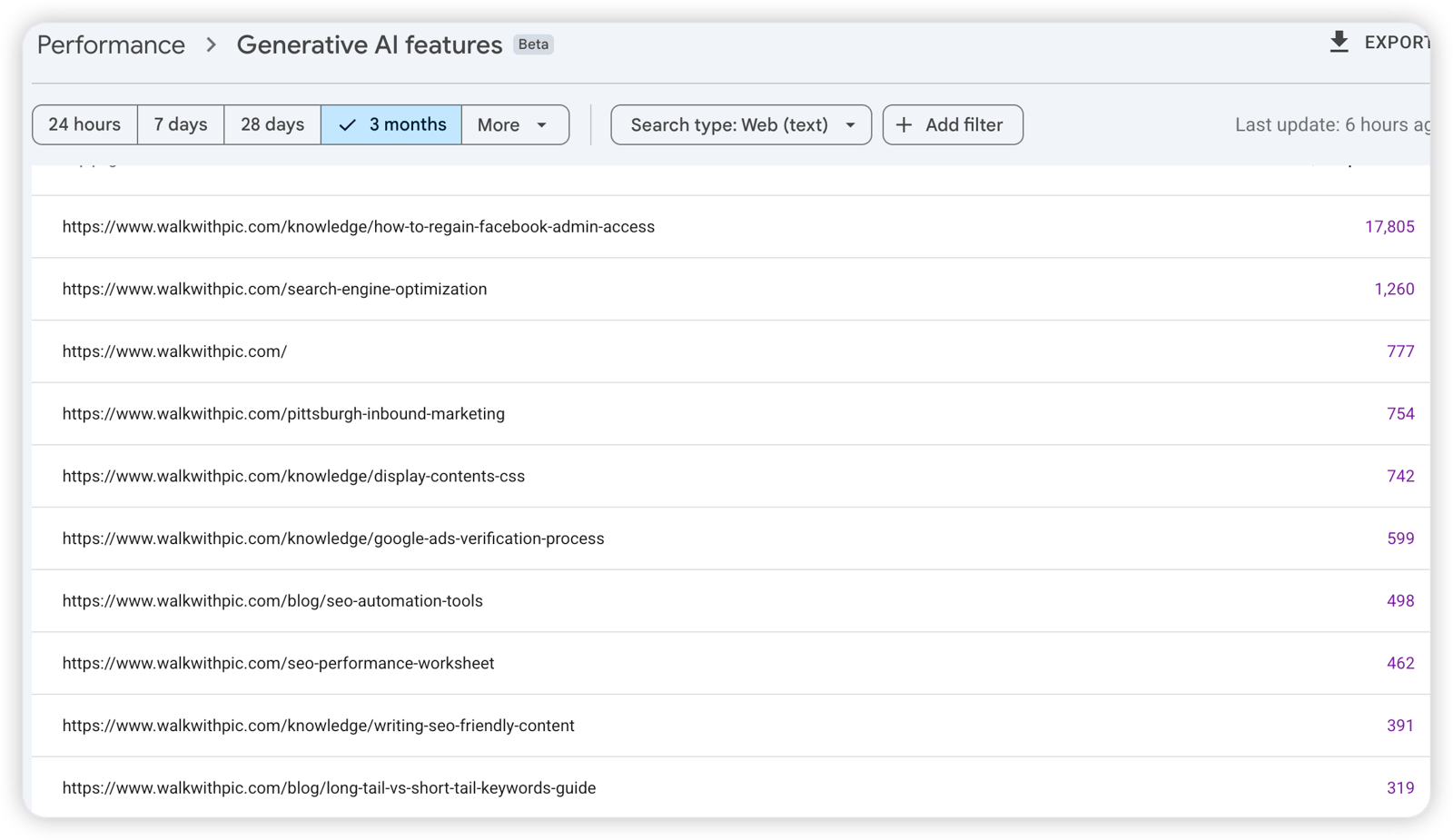
Turning back to the silo, it matters more now, not less. What changed is what goes in it. In 2019 you could fill a silo with competent supporting content and win. Now you need to anticipate the conversation. Answer the users' follow-up questions with a variety of related topics that guide the user through their buyer journey. Some call this "human-centric content"; we call it the Hero Mission Strategy (specifically our storyboard workshop).
Architecture is what your agency can build, and it still matters quite a bit. From title tags, to URL slugs, schema, alt text and whatever the technical factors are this year. Your competitor can buy identical architecture from an equally good agency. Nobody can buy your expert. Value and expertise are challenging to duplicate. Build your moat by posting things you are genuinely proud of.
Back to the question. Why won't subject matter experts help marketing?
This one is for my subject matter experts. You'll hand the sales team two days for a proposal three people read. You'll hand a conference eleven hours on a presentation for 40 attendees.
Meanwhile, thousands of your buyers are having a conversation about your category right now. They are asking deep questions. They are planning their solution. Yet your company is invisible. Your expertise remains on your laptop and not on your website. Help them publish your expertise. Give your marketing team 1-2 hours of what you know. They'll handle the rest. And this time it isn't just traffic on the line. It's where your brand awareness is going to start in 2027.
About the author
Jeff Schroeffel is the founder of PIC (Pittsburgh Internet Consulting), a digital marketing agency. He has worked in search engine optimization since 1999 — from the keyword-stuffing era through every major algorithm shift to today's AI-driven answer engines — and has built PIC's practice on a single principle: earn your rankings, never trick your way into them.