

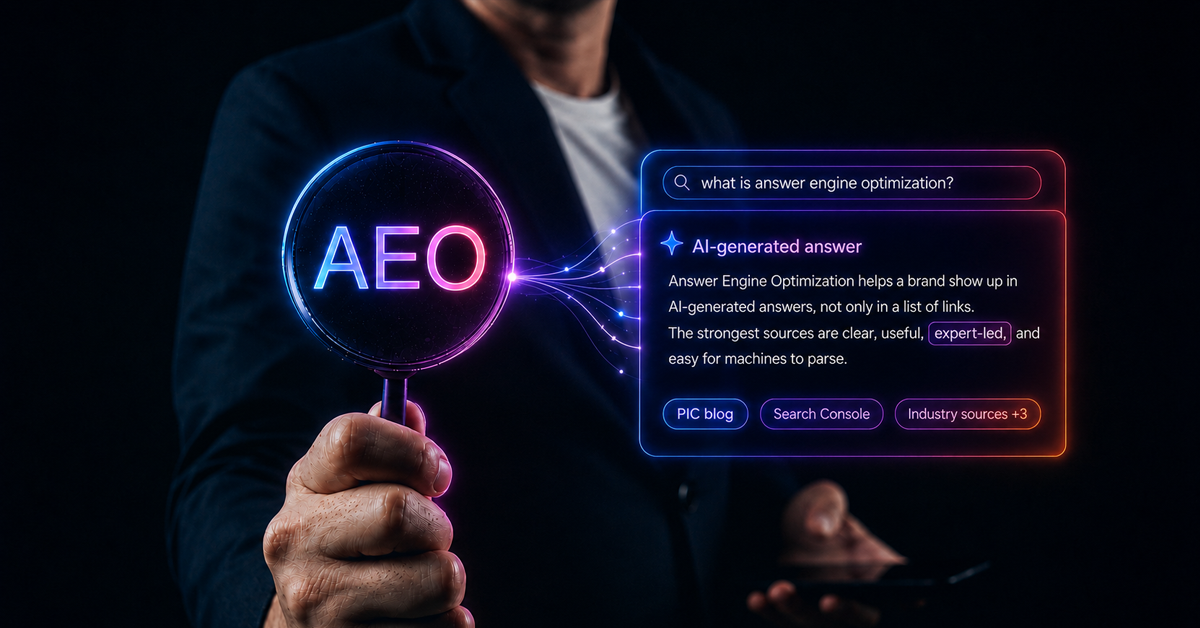
There’s a debate running through every marketing team right now: SEO is dead, and a brand-new discipline called AEO — Answer Engine Optimization — has taken its place. Or the opposite: nothing has really changed, AEO is a buzzword, and good SEO still wins.
Here’s the uncomfortable, useful truth. Both camps are right.
In one sense, the SEO most people picture is over. The ritual of typing a phrase, getting back a page of ten blue links, and clicking one result is fading fast. AI Overviews, ChatGPT, and assistants like Claude increasingly answer the question before a single click happens.
In another sense, this is exactly where Google has been heading for twenty years. An AI-generated answer is just one more layer on top of the same human behavior that has driven search the entire time: a person asks a question, or a series of questions and a machine tries to hand back the best response while they’re still looking for it.
If you understand that pattern, the “SEO vs AEO” argument stops being a crisis and starts being a roadmap. It’s worth noting Google itself frames this as continuous: its own guidance on optimizing for generative AI search is an extension of SEO fundamentals, not a separate rulebook.
Search has always been a stack of layers
Think about how Google truly evolved. When it first introduced paid results, the entire industry panicked and Google quietly kept the ads pinned far to the right of the organic listings. Over time, those ads migrated to the top. The format changed; the underlying job did not.
Then came layer after layer. Maps search. Shopping search. News search. Image search. Video search. YouTube search. Each one looked, at launch, like a new and separate thing. Each one was really the same thing wearing a different interface: a computer trying to understand human information and deliver it to other humans at the moment they need it.
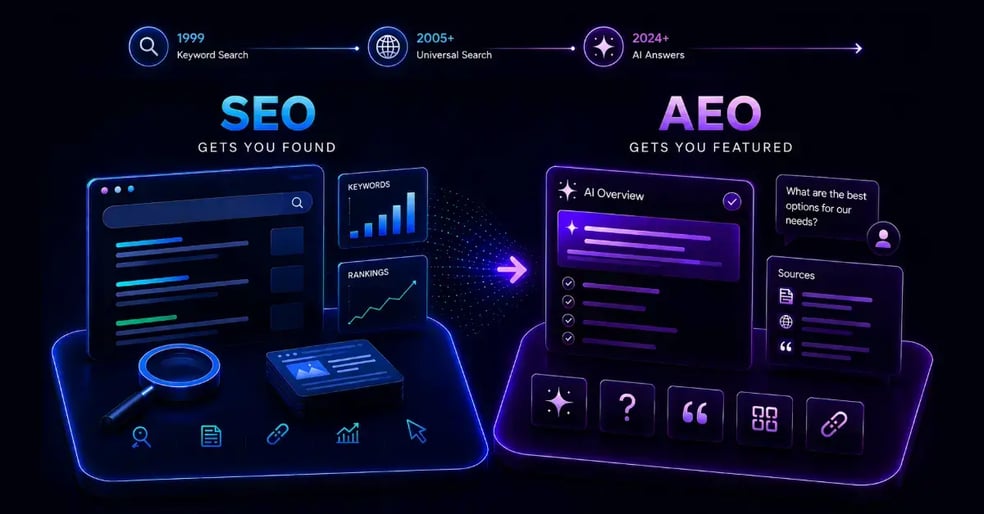
AI answers are simply the newest layer in that stack. Not a replacement for search but an evolution of it. Calling it a brand-new discipline overstates the break. Calling SEO dead misses that the machine is still doing the one job it has always done.
The one rule that never changed
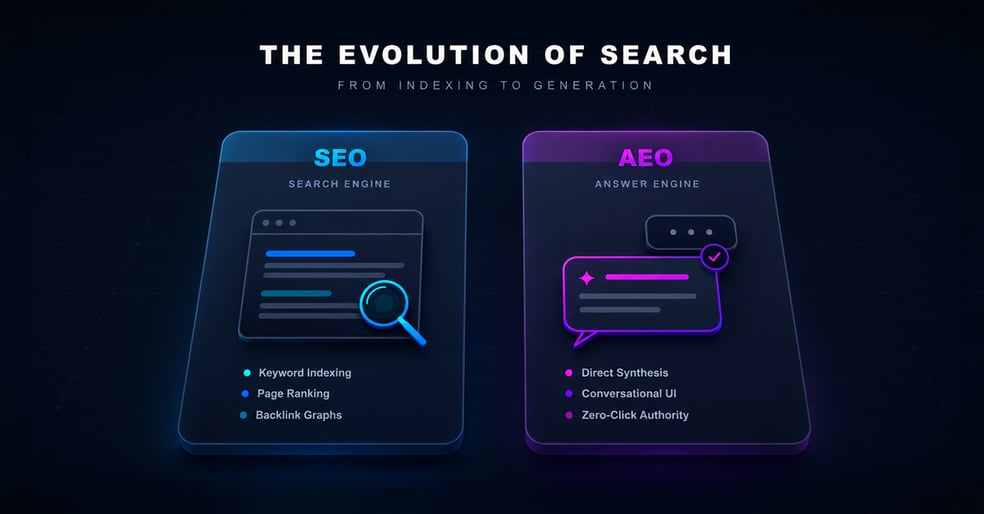
We’ve been optimizing for search engines since 1999 from our Pittsburgh headquarters. In those early days, ranking was almost embarrassingly simple: stuff a page with as many keywords as you could, and you’d climb. White text on a white background, packed with terms no human would ever read. It worked, it didn’t hurt anyone, and there were no rules against it.
Try that today and your page won’t just fail to rank. It won’t get indexed at all, and it will never be referenced in an AI-generated answer.
What changed isn’t the existence of optimization. What changed is the standard. From the very beginning, search engines have been trying to do one thing: rank results based on what the user actually needs in the moment they’re searching. Every algorithm update for twenty-five years has been a step toward measuring that need more accurately. Keyword stuffing died because it stopped being a good proxy for “this answers the question.” The job stayed the same. The bar kept rising.
That single rule — serve the searcher, right now, better than anyone else — is the thread that connects 1999 keyword pages to 2026 AI answers. Master it, and you’re never optimizing for a platform. You’re optimizing for the human the platform is built to serve.
White hat, black hat, and the line that’s always been there
There have always been two ways to play this game.
Black hat SEO exploits whatever gap exists in the rules. Its entire premise is that it works while it works, until the engines close the loophole and the rankings evaporate. In the late ’90s, page stuffing was simply the medium available; with no rules in place, anything that pushed a legitimate client up the list felt fair game.
White hat SEO earns its way to the top instead. It means paying attention to what the engines reward. Historically, signals from people like Matt Cutts and Google’s webspam team, and today the official guidance Google publishes through Search Console and its documentation, and then building the best possible content to answer the user’s query. Earning your position is the signature of a white-hat shop.
That’s the lane PIC has been in since day one. It means technical SEO done right. It means real keyword research. It means deliberate content strategy. It means earning top spots rather than tricking your way into them. The proof is in our retention: clients who have walked this road with us still rank at the top of their categories today. They’re leading.
But white-hat practitioners never get to ignore the black hats. We have to understand every technique they use, because their methods reveal where the engines are still vulnerable and where the next algorithm update is going to land.
The new black hat is AI slop and the engines are already hunting it
Today’s version of white-text-on-white isn’t keyword stuffing. It’s mass-produced AI content with no subject-matter expert and no unique point of view.
If you spin up hundreds of articles that simply re-summarize the same top ten listicles everyone else already published, you’re not building authority. You’re filling the web with garbage and that’s not going to reward you for long. Google’s spam policies now name this directly. “scaled content abuse” explicitly includes using generative AI to produce many pages without adding value, and recent updates have been aimed squarely at it, precisely because it proliferated so fast once generative AI made volume effectively free.
To be clear: this is not an argument against using AI. We use it constantly. We use it for research. We use it to build outlines. We use it to match content to our clients’ heroes the real people their work is meant to serve.
But the most you’ll ever hear us call an AI-assisted piece is an 80% draft. That last 20% is the whole game, because it requires a subject-matter expert. We can hire a technical writer, pull expertise directly from our clients, or do deep research ourselves, but in honesty, we are rarely the leading experts in a client’s field. And to genuinely earn our way into the conversations users are now having inside an LLM or a Claude app, the content needs cutting-edge expertise that’s unique and can’t be reconstructed by skimming the first page of results.
That’s the part no model can fake. It’s also the part that’s about to become the entire competitive advantage.
We’ve been discussing how AI search will affect user behavior
This isn’t theoretical for us. PIC has been debating this very question internally for over a year, and the pace only picked up in 2026. Our strategists and client teams now have a standing mandate: monitor, improve, and optimize for LLM performance, not just classic rankings. This is something the engines are now equipping us to do, with Google rolling out generative-AI performance reports in Search Console in June 2026. On the platform side, we’re rolling out HubSpot’s AEO tool to most of our clients. It tracks your brand’s share of voice, sentiment, and citations across ChatGPT, Gemini, and Perplexity, and connects that visibility data straight to the CRM and content tools where the work gets done.
The arguments we keep having sound like this:
- Is “AEO” its own service and its own project — or is it fine to just keep calling it SEO?
- Do we need a separate page on our site for SEO and AEO, or just one?
- And honestly: is it even “AEO,” or whatever they’re calling it this month?
The structural details will sort themselves out
A lot of the current anxiety is about plumbing. Do you need schema markup, and how much? Should you publish a clean Markdown version of your content so engines can parse it more easily? Do you need an llms.txt file or a structured outline so AI systems can index everything you know?
A word of caution on that last one, because the hype is ahead of the facts: for Google specifically, none of it is a ranking factor. Google states plainly that you don’t need to create new machine-readable files, AI text files, or markup to appear in AI Overviews or AI Mode. So, we treat llms.txt and Markdown versions as a forward-looking bet on the broader LLM ecosystem — how a ChatGPT or a Claude might more cleanly consume your content — not as a lever that moves Google rankings today.
Our honest answer on the rest: that structural, behind-the-scenes hierarchy will largely work itself out over the next year. We’re in a period of genuinely rapid change, and the technical conventions are still being written. Stay current, implement the sensible standards as they stabilize, but don’t mistake the plumbing for the building.
For our fellow SEO/AEO nerds — a worked example: schema.
Schema markup was recommended, so we added it, and we still consider it valuable. But we’re putting less emphasis on it, because the major players really are stepping back. Google first restricted FAQ rich results to government and health sites in 2023, and in 2026 it sunset them entirely. The rich results stopped showing in May and the reporting is being retired through the summer.
Here’s the nuance, though. Schema is just the practice of organizing your content in logical, machine-readable ways, and that need isn’t going anywhere. We expect the concept to stay important even as the code behind it changes.
Which is why one of our favorite phrases at PIC is “it depends.” There’s a lot of nuance in where search and answer optimization are heading, and anyone selling you certainty right now is selling you the new white-text-on-white.
Because here’s what won’t change: Google, Anthropic, OpenAI, and everyone who follows them are all competing to serve their users well and to make their own businesses perform. The only durable way to win that competition is to surface quality content written by true experts who earned their authority. That requirement has survived every layer search has ever added. It will survive this one too.
So, Is SEO dead in 2026?
The short answer is no. SEO isn’t dead, it’s being absorbed into something larger, and that’s exactly why the “SEO is alive” camp has it right. So how can people insist SEO never died? Because of where this is heading.
Two years from now, we won’t be drawing a line between “AI search” and “organic search” any more than we today separate “image search” from “news search.” It will all just be search again. One merged result set delivered across a handful of different providers. You’ll still ask questions. You’ll still research. You’ll still look things up in your conversations. The interface will keep changing; the behavior won’t.
How PIC wins SEO and AEO
AEO and SEO aren’t rivals. They’re the same discipline at two points on a very long timeline. The businesses that win the AI era will be the same ones that won every prior era. The ones who refused to chase loopholes and instead did the patient, expert work of earning the answer.
That’s the work we’ve been doing since 1999. We’d be glad to do it for you.
Want to know whether your content is built to earn its way into AI answers or just adding to the noise? See how we approach AEO, or let’s talk.