
You’ve met Marketing Mary before. She’s one of our heroes — the marketing director or high-end coordinator who owns the whole marketing engine at her company, whether that’s a team or a team of one. She’s been at this for a long time. She’s good.
But she’s got problems. Maybe she can’t report her ROI cleanly. Maybe her web company can’t move fast enough. Maybe she can’t keep her own site fresh. So, she does what every hero does when they’re on a mission: she goes looking for a way to solve it. Her search engine. Her LLM. Her social feeds, her referral network. Her peer groups. She’s hunting for a solution.
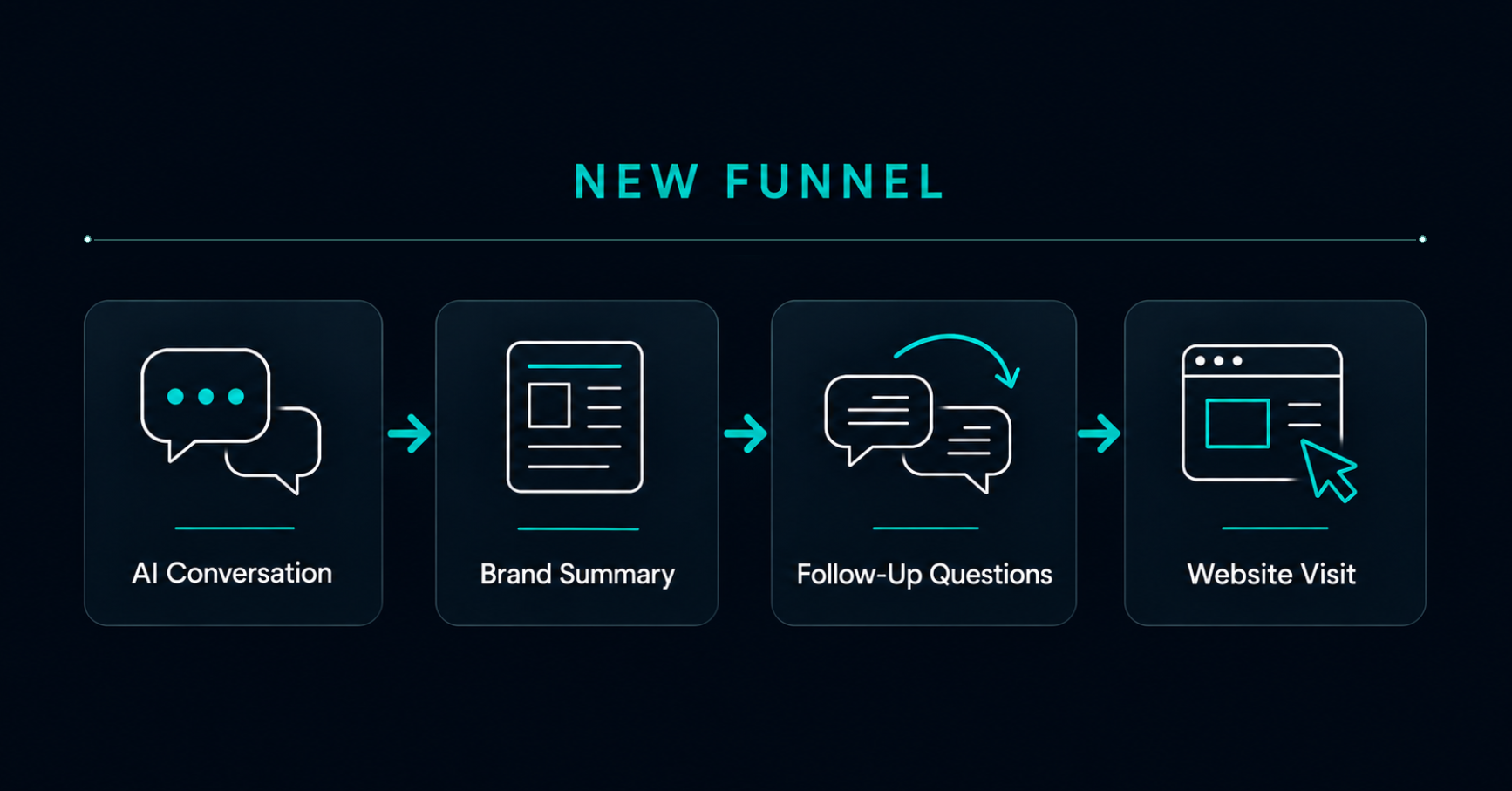
She’s doing exactly what I wrote about last time: the search became a conversation. And it’s a longer conversation than people assume — Gartner found AI summaries make people spend more time researching, not less, with two-thirds of them pushing right past the AI Overview to keep digging.
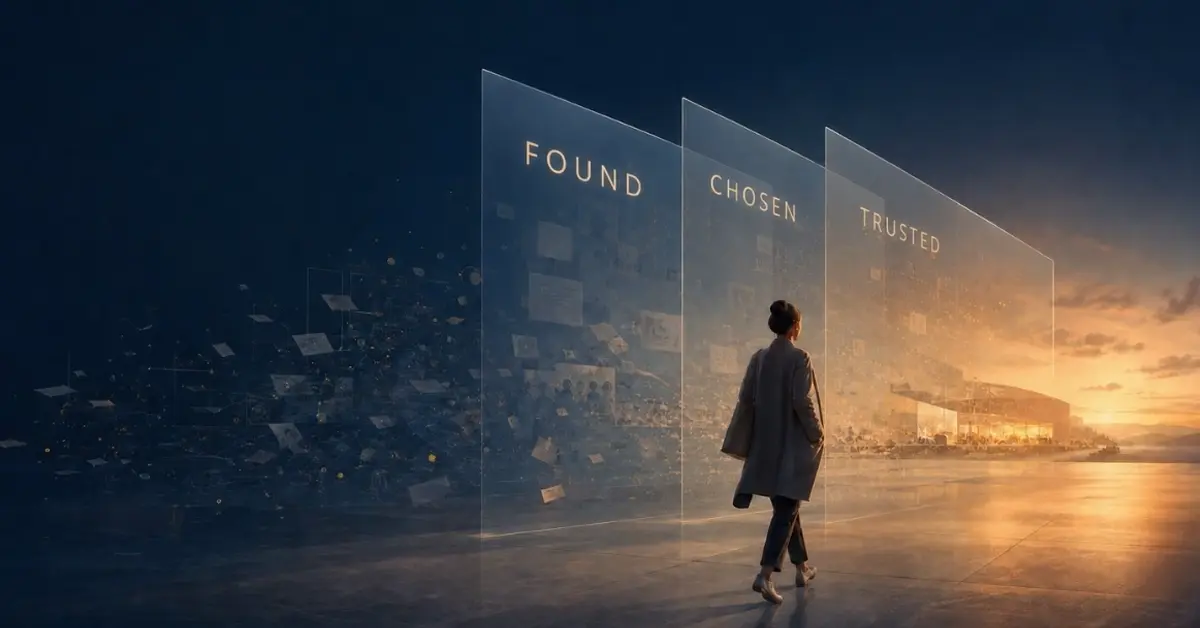
Our job is to be there when she looks. That’s the whole game, and it breaks into three missions: get found, get chosen, get trusted.
Found
Here’s the thing 25 years in this business taught me: referrals, word of mouth, and keeping the clients we already have are still our most effective channels. People who hired us loved it and hired us again. We were found, chosen, and trusted by them for years. Our average client relationship is seven years, including clients who partnered with us this year through numerous relationships of more than 20 years.
But the front door is changing. The latest collision I can’t stop thinking about isn’t organic search vs. AI. It’s paid search vs. AI.
Picture your perfect-fit client. He starts on Google, sees your paid ad — the one you’re paying a good bit for and sweating the cost-per-SQL on — and clicks. He lands on your site, grabs your content, and feeds it into his LLM to get a second opinion. Then he drops it into an internal doc that’s quietly evaluating three vendors. You? You got a quality visit and nothing else. No email. No signal. And right now he’s presenting your material to his board.
How do we track that? Mostly, we can’t. Which is exactly why getting found has to shift. AEO — showing up inside the AI results is one primary and emerging way of being found. But you can’t stop there. You keep building the brand through social awareness so that when the LLM does mention, cite, or link a source, it’s you it reaches for.
Chosen
Found is the first barrier. Now you have to get picked. Does your brand affinity get you deeper in the conversation?
In the old days, “chosen” meant a whitepaper download, a nurture track, a BDR reaching out, and someone convincing the buyer to pick you. Is that how it works now? Not really. Today they keep researching. They slice the numbers, pull budget figures, maybe talk to sales a little, but they’d rather stay out of the sales pressure as long as they can. Then more research. Then the presentation.
When do you find out you made the short list? Later. Further down the journey than you’d like, often long after the decision’s momentum is already set. We see it happening to us and to our clients — buyers show up already deep in, already educated, already leaning.
And this isn’t a hunch. 6Sense found buyers typically don’t engage a seller until they’re roughly two-thirds of the way through their journey — and the overwhelming majority end up buying from a vendor that was on their short list from the very start. By the time you know the game is on, it’s nearly over.
Buyers are two-thirds through their journey before they ever contact you.
— 6Sense B2B Buyer Experience Report, 2025
So how do you get chosen when they won’t raise their hand? You convince them with your valuable content, your user experience, and the way they get to experience your brand — on their terms, not yours.
And “chosen” isn’t one-size-fits-all. It’s hero-dependent. If your hero is an engineer, they may want a dense, detailed case study. Mary wants a tool she can test or an attribution concept that helps her track ROI better. Different hero, different proof. The goal’s the same: get your hero to build their decision on your content.
That’s why we’re building out our webinar series. It’s genuinely useful to Mary, it throws off great long-term content, and our team gets sharper every time we make one. Like most agencies, we’ve always put our clients’ marketing ahead of our own — the old shoemaker’s-kids story. Now we’re pointing that same energy at Mary. The goal is to make our site the one that talks to her.
A client said something recently that stuck with me — a colleague of his is pushing the phrase “human-centric content” internally. Couldn’t agree more. That’s our Hero Mission Strategy in three words. Get to the core truth. The real pain, not the marketing version of it. Where’s she going, and what does she need next? Then give her that — a calculator [add link: SEO calculator], a graphic, a video — built around the questions she’s asking, not the keywords we wish she’d type.
Trusted
We got found. We got chosen. Now comes the one that lasts: trust.
Start with what trust even means. One of our core values is I trust the team and the team trusts me. It’s mutual. You give people the benefit of the doubt, you expect they’ll do what they said, and you both earn it by coming through — over and over.
So how does a brand earn that through a website? The small things add up. Clean user experience. Support that’s easy to reach. Chat that blends real humans with smart automation. And voice-of-the-customer proof — reviews, testimonials, case studies. You need that trust before the deal closes. You need it just as much after someone’s been a client for years.
And here’s where the outside world does your talking for you. When Ahrefs studied 75,000 brands, the strongest predictor of showing up in AI answers wasn’t backlinks or how much you’d published — it was how often independent sources mentioned your brand, by roughly three to one.
Trust isn’t something you claim. It’s what other people say about you when you’re not in the room.
I think one reason we keep clients as long as we do is that they see us as thought leaders. That means practicing what we preach and putting the work out — through our newsletters, in our cadence meetings, wherever it’s useful. And that content doesn’t just feed the website or our egos. It lives in our knowledge bases, our training, our onboarding. We try to squeeze every bit of life out of a good piece.
We were looking at a client’s blog this week — one post, written years ago by a true industry pro, someone who kept a blog before blogs were cool. He hasn’t written a word in a decade. That post is still pulling traffic. Because it’s expert, original, and well-made.
Now compare that to the AI slop somebody published last week — the post that’s just ChatGPT summarizing what everyone else already said. It might’ve gotten a little pop the day it went live. But it won’t last. Nobody will cite it. It won’t live on. It becomes the thing you have to clean up in a couple years. Google’s own rater guidelines now tell reviewers to hand the lowest possible score to a page that’s almost entirely AI-generated with nothing original added. The engines are being trained to do exactly what your sharpest readers already do — skip it.
That’s the whole point. Content builds trust when it’s real: a case study that names Mary’s exact problem so precisely she knows you can solve it, because you already did. or a video where you explain the benefit in your own words, with your own pitch. But you can only make that if you truly know your hero.
We call her a hero, not a persona, on purpose. A persona feels like a target. We’d rather be the champion than the marksman. Understand who she is, not just what we want to tell her. Get to her core motivation and her human truth — and that’s the moment trust becomes possible. Whether that means she stays with us for years, or picks us for the very first time.
So here’s where it all lands. Found, chosen, or trusted — whatever you’re writing for: if it’s unique and it adds real value, it’ll pay off in AEO. If it’s compiled information anyone could have written, it’ll die on the vine.
Like I said when this series started, SEO isn’t dead — it’s evolving. This is what it’s evolving into.
Be the champion. Make the thing only you could make.
Author’s note
A good friend of mine — Dave Meyer over at BizzyWeb — beat me to some of this. Dave and I have each been doing this for 25 years, from opposite corners of the country, and when I read how he was framing the shift to AI search, I had to laugh. We’d independently landed on almost the same three words. He talks about getting found, cited, and chosen. I’ve been writing about getting found, chosen, and trusted.
That overlap isn’t a coincidence. When two people who’ve spent a quarter century pick up the same direction, it’s a good signal to me.
Dave’s one of the sharpest operators I know, and the fact that we’re both seeing the same thing is the best evidence I’ve got that this is the right direction for PIC, our clients, and our hero, Marketing Mary.
Cheers Dave